
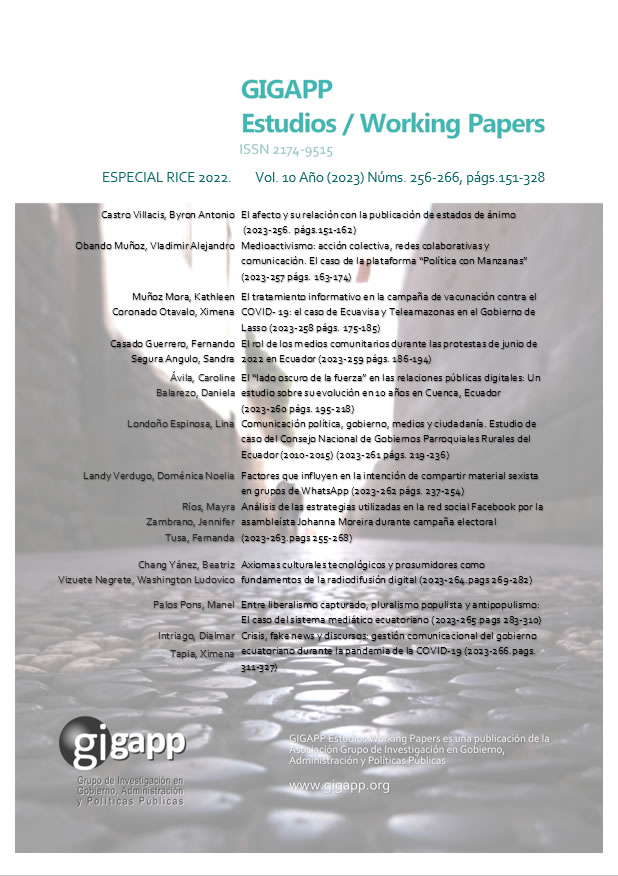
Affection and its relationship with the publication of moods
Abstract
The constant publication in social networks of statuses generates expectations in contacts of both known and unknown people, making known what is done has become a necessity for both young people and adults who want to project an image that is often false, and that in turn seeks personal recognition. The objective of this work was to analyze why people look for a social network, to transmit and communicate their moods, attention, emotion, and the perception of affection are considered in a cybernetic world. Through a bibliographic review and through surveys of a participatory sample of 30 women members of the Iron Horse Riders Motoclub between 30 and 40 years of age, it is described that this new way of expressing themselves generates a lack of communication between close family members and social isolation. , which leads to the search for acceptance -in many cases from unknown people. We can realize that a serious problem is created with respect to interpersonal communication and face-to-face treatment, since electronic communications are being put above all, which do not have the sense of warmth and personal affection. In conclusion, electronic devices connect us more with those who are far away and at the same time disconnect us from those who are close.
Downloads
References
CNN-Salud. (2020). cnnespanol.cnn.com. https://cnnespanol.cnn.com/2020/02/10/la-cirugia-plastica-inspirada-en- filtros-y-aplicaciones-de-edicion-de-fotos-no-va-a-desaparecer/
El periodico. (2019). elperiodico.com. https://www.elperiodico.com/es/sociedad/20191130/obsesion-filtros- belleza-instagram-autoestima-cirugia-estetica-efectos-psicologicos- 7743564
Forgas Joseph, P. (2002). Hacia la comprensión del afecto en el pensamiento y el comportamiento sociales. Revista internacional para el avance de la teoría psicológica, 13(1), 90-102. https://www.tandfonline.com/doi/abs/10.1207/S15327965PLI1301_03?co okieSet=1
Gil, V. D. (2017). Necesidad de reconocimiento y síndrome de selfie: un análisis relacional basado en minería de datos. Ingenierías USBMed, 8(1), 71-76. http://www.revistas.usb.edu.co/index.php/IngUSBmed/article/view/2835/2 504
Leung L. (2013). Generational differences in content generation in social media: The roles of the gratifications sought and of narcissism. Computers in
Human Behavior, 29(3), 997-1006. https://doi.org/https://www.sciencedirect.com/science/article/abs/pii/S074 7563212003706
Malcolm A. Pikoos T. Castle DJ. Labuschagne I. & Rossell SL. (2021). Identity and shame in body dysmorphic disorder as compared to obsessive- compulsive disorder. Journal of Obsessive-Compulsive and Related Disorders, 31. https://reader.elsevier.com/reader/sd/pii/S221136492100066X
Mayank, V. (2 de 2 de 2015). Síndrome de selfie: un regalo infeccioso de TI para el cuidado de la salud J Lung, Pulmonary & Respiratory, 48.
Ong EYL. Ang RP. Ho JCM. LIm JCY. Goh DH. Lee ChS. Chua AYK. (2011). Narcissism, extraversion and adolescents’ self-presentation on Facebook.
Personality and individual differences, 50(2), 180-185. https://www.sciencedirect.com/science/article/abs/pii/S01918869100046 54
Real Academica Española. (2021). Diccionario de la lengua española, 23.ª ed., [versión 23.5 en línea]. https://dle.rae.es
Robin-Marie Shepherd, R. J. (2005). Reasons for internet use and social anxiety.
Personality and Individual Differences, 39(5), 949-958. https://www.sciencedirect.com/science/article/abs/pii/S01918869050012 61
Time. (2014). time.com. https://time.com/35701/selfie-addict-attempts-suicide/
Torres AR. Ferrão YA. y Miguel EC. (2005). Trastorno dismórfico corporal: ¿una expresión alternativa al trastorno obsesivo-compulsivo? Revista Brasileira de Psiquiatria (Sao Paulo, Brasil), 27(2), 95-96. https://www.scielo.br/j/rbp/a/6KGDMDn3wJFGvkcVFQfNgyD/?lang=pt&f ormat=pdf
Valkenburg, P. y. (2011). Comunicación en línea entre adolescentes: un modelo integrado de su atracción, oportunidades y riesgos. Revista de salud adolescente, 48(2), 121-127. https://www.sciencedirect.com/science/article/abs/pii/S1054139X100042 6X
Vanguardia, L. (2018). lavanguardia.com. https://www.lavanguardia.com/cribeo/cultura/20180220/47423045383/los-selfies-tendrian-la-culpa-del-aumento-de-las-operaciones-de-cirugia- estetica-entre-los-menores-de-30-anos.html
Villacis B. A. C., F. L. (2018). La importancia de las TIC en la construcción de opinión pública de los emprendimientos. INNOVA Research Journal, 3(2), 147-160.
Wang JL. Jackson LA. Zhang DJ. Qiang Su Z. (2012). The relationships among the Big Five Personality factors, self-esteem, narcissism, and sensation- seeking to Chinese University students’ uses of social networking sites (SNSs). Computers in human Behavior, 28(6), 2313-2319. https://www.sciencedirect.com/science/article/abs/pii/S07475632120020 14
Copyright (c) 2023 Byron Antonio Castro Villacis (Autor/a)

This work is licensed under a Creative Commons Attribution-NonCommercial-ShareAlike 4.0 International License.
Those authors who have publications with this journal, accept the following terms:
a. Authors will retain their copyrights and guarantee the journal the right of first publication of their work, which will be simultaneously subject to the Creative Commons Attribution-NonCommercial-ShareAlike 4.0 International (CC BY-NC-SA Recognition License). 4.0) that allows third parties to share the work as long as its author and its first publication are indicated in this journal.
Under this open access license, readers (users) can:
- Share — copy and redistribute the material in any medium or format
- Adapt — remix, transform, and build upon the material
Under the following terms:
-
Attribution — Users must give appropriate credit, provide a link to the license, and indicate if changes were made. You may do so in any reasonable manner, but not in any way that suggests the licensor endorses you or your use.
-
NonCommercial — Users may not use the material for commercial purposes.
-
ShareAlike — If remix, transform, or build upon the material, users must distribute your contributions under the same license as the original.
- No additional restrictions — Users may not apply legal terms or technological measures that legally restrict others from doing anything the license permits.
b. Authors may adopt other non-exclusive license agreements for the distribution of the version of the published work (eg: deposit it in an institutional telematic archive or publish it in a monographic volume) provided that the initial publication in this journal is indicated.
c. Authors are allowed and recommended to disseminate their work through the Internet (e.g. in institutional telematic files or on their website) before and during the submission process, which can lead to interesting exchanges and increase citations of the published work. (See The effects of open access).